The Open Bioinformatics Foundation (OBF) Event Fellowship program aims to promote diverse participation at events promoting open-source bioinformatics software development and open science practices in the biological research community. Jeremy Fan, an independent researcher, was awarded an OBF Event Fellowship to attend the Bioinformatics Open Source Conference (BOSC) 2026.
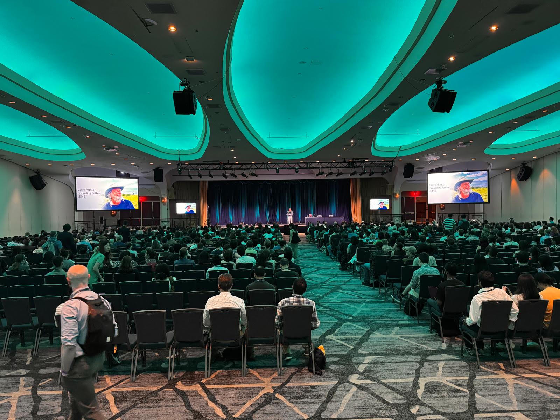
The opening session at ISMB 2026
I want to thank the BOSC committee and all the organizers at the conference. At BOSC 2026, I presented BioFmt, attended talks on AI-assisted work, and spoke with researchers building small, specialized tools. Those conversations were a chance to connect my own experience with what others were working on. A recurring theme for me was how we check the software and scientific outputs that are becoming easier to produce.
What stood out in the talks
Several talks I attended brought this question into focus. Geraldine Van der Auwera and colleagues described using AI to develop, maintain and translate bioinformatics training materials, shortening work that had taken days to hours. The WILDS team described using LLMs to prototype workflow modules while keeping human review and validation in the process. These examples connected with my own experience building BioFmt: generating something quickly still leaves the work of checking it.
Presenting BioFmt
BioFmt was my first VS Code extension, built with AI assistance around a constrained problem where I could check outputs against explicit formatting rules. What surprised me at BOSC was how many researchers were independently building small, specialized tools around similar problems. Conversations around projects such as TreeMapper and other FAIR-focused infrastructure reinforced the value of making scientific data easier to validate, interpret and reuse.
My main takeaway from BOSC was that making software easier to build makes verification and domain expertise more important. The talks and conversations reinforced my view that open source has a role to play here: code, tests and reproducible workflows let others inspect and challenge what we produce. Open source will not remove the need for scientific judgment; if anything, it makes that judgment easier to apply.