Rhett Sutphin provides a mini-primer and some example code that shows how to view Chromatogram files with java.
His full posting can be read here: http://pw600a.bioperl.org/pipermail/biojava-l/2003-June/003896.html
The Open Bioinformatics Foundation (OBF) is a non-profit, volunteer-run group that promotes open source software development and Open Science within the biological research community. Membership in the OBF is free and open to anyone who wants to help promote open source or open science in a biological field.
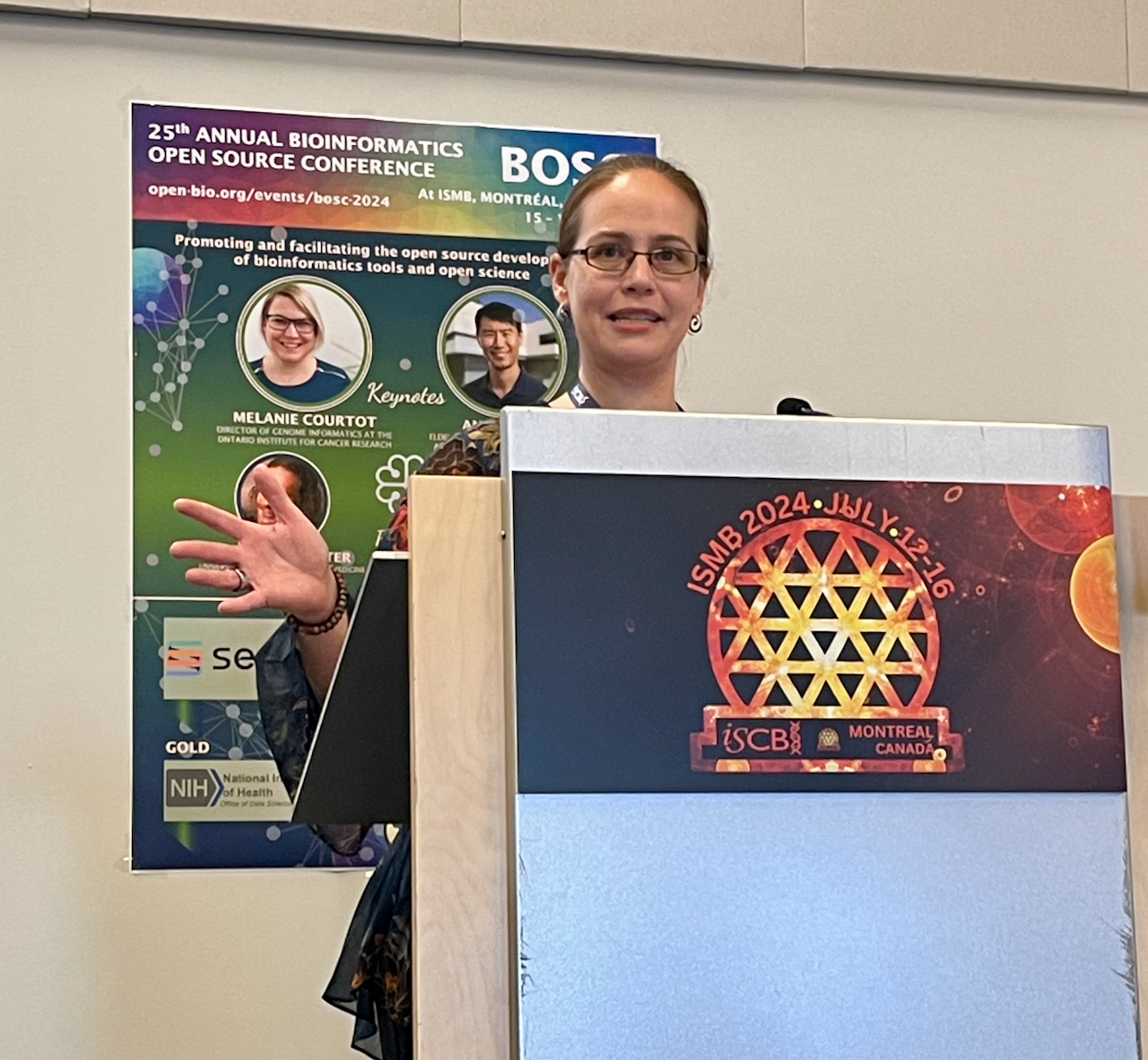
OBF runs the annual Bioinformatics Open Source Conference (BOSC).
BOSC 2025 took place July 21-22, 2025, in Liverpool, UK (as part of ISMB/ECCB 2025). BOSC 2026 will be part of ISMB 2026 in Washington, DC.


The OBF Event Fellowship program aims to increase diverse participation at events promoting open source bioinformatics software development and open science in the biological research community.

Rhett Sutphin provides a mini-primer and some example code that shows how to view Chromatogram files with java.
His full posting can be read here: http://pw600a.bioperl.org/pipermail/biojava-l/2003-June/003896.html
Do you need to access sequences from multiple places? Would you like to easily retrieve your own local sequences from indexed flat files, all other sequences on species X from department wide raletional database and the rest from global internet servers?
The Open Biological Database Access (OBDA) System was designed so that one could use the same application code to access data from all three of the database types by simply changing a few lines in a “configuration file”. This makes application code more portable and easier to maintain.
[Read More]Mark writes:
The tutorial site BioJava in Anger has been updated so the code examples reflect the new APIs in the upcomming BioJava 1.3 release. Take a peek at http://bioconf.otago.ac.nz/biojava
Shawn Hoon announces the release of bioperl-run-1.2.0 which is an extention to the bioperl framework that contains modules that act as wrappers for common informatics applications.
The full release announcement can be read here: http://bioperl.org/pipermail/bioperl-l/2003-May/012308.html
Jonathan Epstein has a simple script and directions for browsing bioperl list traffic offline via a mobile device.
The full post can be read online at: http://bioperl.org/pipermail/bioperl-l/2003-May/012287.html
Tony writes: {{ double-space-with-newline }} I have just checked in to the Bio::Das perl beta CVS repository (“Bio-Das2”) a collection of modules that creates a minimal DAS reference server from a single AGP file (or a directory of one or more files). There is also a sample server script in the “eg” directory.
Briefly, the server is started using something like:
cd ./eg
./agpserver --dsn ncbi31 --port 3000 --agpfile ./AGP/chr1.agp
It can then be used by a DAS client in the normal way. It is simple (no frills!) and capable of serving assembly information, entry_points, DSN info, features across a segment and features by ID. No other DAS commands are supported yet.
[Read More]Jason writes:
I’ve added a parser for the ab initio gene predictor GlimmerM in Bio::Tools::Glimmer. Tests are added to t/Genpred.t now.
It follows the Bio::Tools::AnalysisParser interface which support the next_prediction call and returns a Bio::Tools::Prediction::Gene object in the same way as Genscan.
I also have some scripts for building the training set file so you can run Glimmer on other species. There is also a similar script for building custom splice sites file for Genewise which I’ll commit soon. Basically it takes as input a GFF file which has exons annotated (typically from Sim4/Exonerate alignments of cDNA to DNA) and a reference to the genomic DNA db (typically just a flatfile which we index with Bio::DB::Flat).
[Read More]Hilmar writes:
I got the Oracle version of the biosql schema fully migrated, at least as far as I can tell from here. I’m going to commit the new version some time today. There will also be a sql*plus migration script from pre-Singapore to the current version that supposedly keeps your data intact (be sure to read the disclaimer though).
This means we’re getting ready to release Biosql 1.0, possibly as early as next week. If anyone sees any problems with the current schema that he/she thinks should be corrected before this release, please speak up now. I guess I should make an effort and generate an updated ERD before release; the dated ones are confusing wrt the current schema. If there is consensus I’ll put out a release candidate early next week.
[Read More]Heikki writes:
Philip Lijnzaad has written a new sequence format module called ’tab’. It is in CVS. Here is the blurb he wrote:
It is very useful when doing large scale stuff using the Unix command line utilities (grep, sort, awk, sed, split, you name it). Imagine that you have a format converter ‘seqconvert’ along the following lines:
my $in = Bio::SeqIO->newFh(-fh => *STDIN , '-format' => $from);
my $out = Bio::SeqIO->newFh(-fh=> *STDOUT, '-format' => $to);
print $out $_ while <$in>;
then you can very easily filter sequence files for duplicates as:
[Read More]